










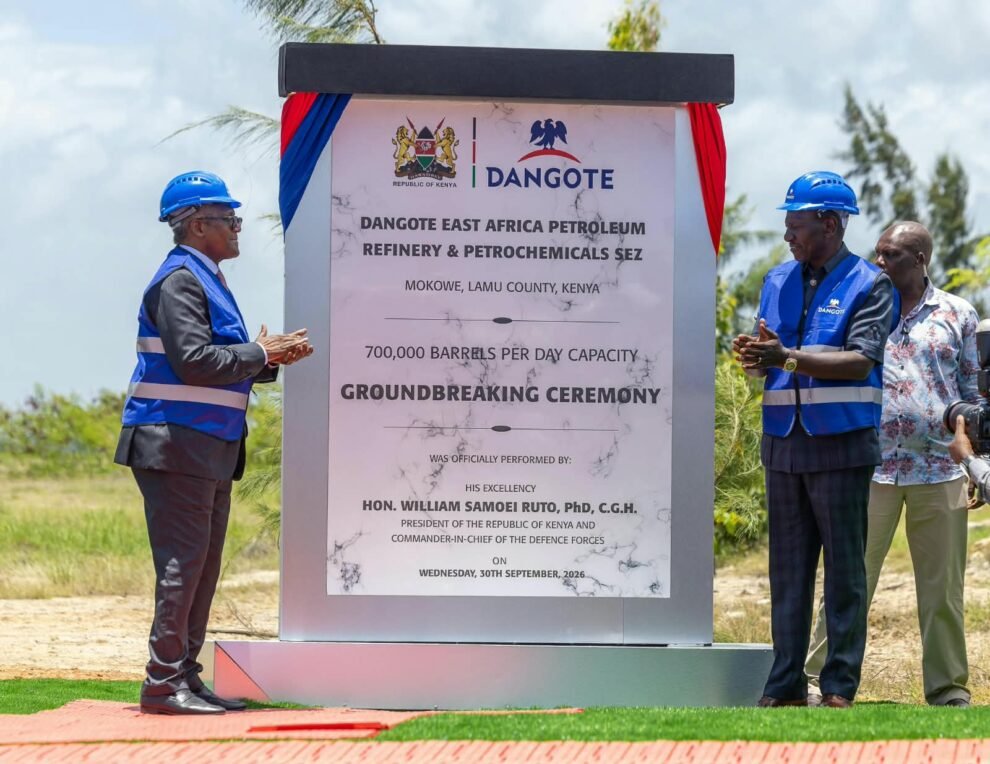
Nigerian industrialist Aliko Dangote and Kenyan President William Ruto formally broke ground on a $16 billion (£12 billion) oil refinery in Lamu County, marking the start of what is projected to become East Africa’s largest industrial facility by refining capacity. The project, officially known as the Dangote East Africa Petroleum Refinery, is designed to process 700,000 barrels of crude oil per day and is expected to significantly reduce the region’s long-standing dependence on imported refined petroleum products.
The groundbreaking ceremony, held at the Kililana site within the Lamu Port-South Sudan-Ethiopia Transport (LAPSSET) Corridor, was attended by several African leaders, including Uganda’s President Yoweri Museveni and Ethiopia’s Prime Minister Abiy Ahmed, alongside representatives from Benin and Togo.
President Ruto described the investment as Kenya’s largest foreign direct investment since independence and an important step towards energy security, industrialisation and regional integration. He further claimed the facility could increase Kenya’s annual gross domestic product by as much as 12%.
Dangote, Africa’s richest man, pledged to complete and commission the refinery within 40 months. The complex will also generate up to 1,000 megawatts of electricity, with a substantial portion potentially available for the Kenyan national grid. Projections indicate the creation of approximately 60,000 direct and indirect jobs.
Plans for Local Skills and Regional Ownership
In addition, Dangote announced plans to establish an engineering training school in Lamu to develop local technical capacity. Regional governments have been offered a combined 30% equity stake, with payments structured over four years, and the company intends eventually to list shares on the Nairobi Securities Exchange.
Construction preparations are already under way. Heavy machinery, including nearly 3,000 metric tonnes of equipment, has begun arriving at Lamu Port. Key partners include Engineers India Limited, awarded a $450 million engineering contract, and Honeywell Technologies for technological support. The refinery is expected to source crude from regional producers as well as from the Middle East and the United States (Kenya Ports Authority, as cited in multiple reports, 2026).
Despite the optimistic outlook, the project has faced local challenges. Prior to the groundbreaking, some Lamu residents staged protests demanding improved compensation for land affected by the development. Environmental concerns have also been raised regarding the potential impact on Lamu Old Town, a UNESCO World Heritage site, and surrounding marine ecosystems. Dangote dismissed the protests as external interference, affirming that construction would proceed as scheduled (BBC, 2026).
If delivered on time and to the stated specifications, the Lamu refinery has the potential to transform East Africa’s energy landscape, reduce foreign-exchange outflows on fuel imports, and stimulate industrial growth across the region. Its success will, however, depend on transparent handling of community concerns, reliable crude supply chains, and sustained political and regulatory support.
Click here





Add Comment