










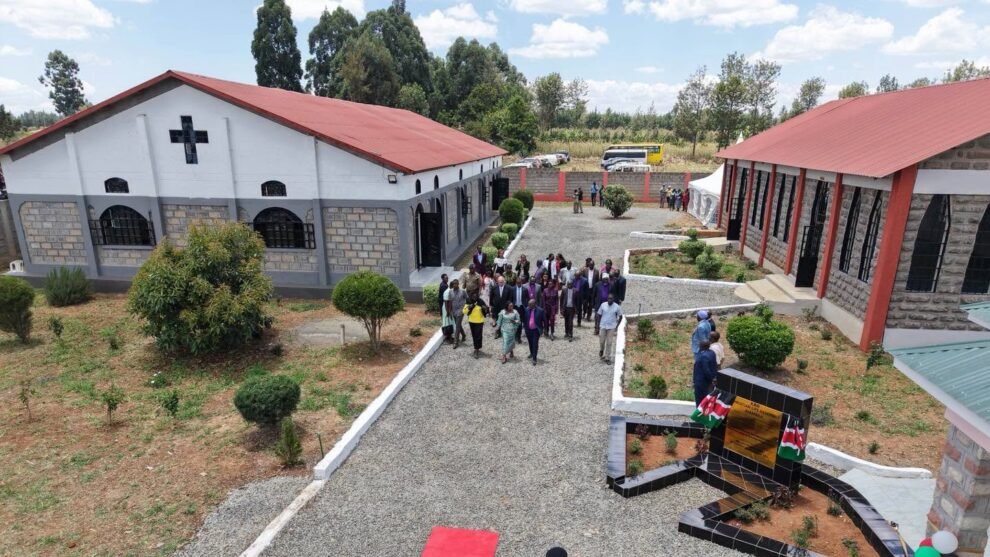
First Lady Rachel Ruto officially reopened the rebuilt KAG Christian Life Assembly Church in Kiambaa, Uasin Gishu County, on Friday. The ceremony was presented as a moment of remembrance, reconciliation and renewed hope. Yet the high-profile event has also prompted quieter questions about timing, symbolism, political optics and whether physical reconstruction can ever fully address the deep wounds left by one of the darkest episodes of Kenya’s 2007–2008 post-election violence.
Nearly eighteen years after the original Kenya Assemblies of God (KAG) church was destroyed by fire, a modern complex now stands on the same ground. The reopening marks a dramatic transformation of a site that, for many Kenyans, remains synonymous with horror.
The events of 1 January 2008
On New Year’s Day 2008, as ethnic clashes intensified following the disputed December 2007 presidential election, dozens of people sought refuge inside the Kiambaa KAG church near Eldoret. Many of those who fled there were Kikuyu families trying to escape the violence that had erupted across parts of the Rift Valley. A mob surrounded the building and set it ablaze. More than 30 people, including women and children, died in the flames or from related injuries. Others suffered severe burns and lifelong trauma.
The Kiambaa church attack quickly became one of the most visceral and widely reported symbols of the post-election violence. Nationwide, the crisis claimed more than 1,100 lives and forced more than 600,000 people from their homes. The images of the burnt church and the stories of those trapped inside left a lasting mark on the national conscience.
For years afterwards the site remained largely associated with loss. A makeshift structure later appeared nearby, but full reconstruction of a permanent church only began in 2022 , more than thirteen years after the original building was destroyed. The long delay reflected both practical and political complications surrounding the location and its painful history.
The First Lady’s message
In her address, Rachel Ruto framed the occasion as a day of reflection and hope.
“We gather as a congregation, a community and a nation to honour the memory of those we lost. We give thanks to the faith that endured and the heart that chose reconciliation.”
She described the reopening as the start of a new chapter of faith and community fellowship, one that honours the memories carried by the Kiambaa community while celebrating its resilience and determination to move forward together. Rachel also conveyed warm greetings from President William Ruto and expressed the hope that the church would become known for transforming lives, restoring hope and helping to build peace in Uasin Gishu and across Kenya.
Healing, optics and unanswered questions
For many supporters of the reopening, the new buildings represent a tangible step towards reclaiming a place of trauma and turning it once again into a centre of worship and everyday community life. The presence of the First Lady was welcomed by some as a high-level acknowledgement of the community’s suffering and its efforts to rebuild.
Others, however, view the ceremony through a more sceptical lens. The involvement of Rachel Ruto, and by extension the current administration, has raised questions about political symbolism. Critics ask whether the reopening risks presenting physical reconstruction as sufficient closure, while deeper issues of justice, accountability, inter-communal trust and historical memory remain unresolved. The long gap between the 2008 attack and the start of serious rebuilding has also been noted, as has the broader political context in which the ceremony took place.
Some observers point out that genuine reconciliation requires more than new walls and carefully worded speeches. It involves sustained dialogue between communities, acknowledgment of past wrongs, and efforts to ensure that political competition never again descends into ethnic violence. Whether the new Kiambaa church becomes a genuine site of shared healing or remains primarily a symbol of one community’s recovery is a question that only time and continued local engagement will answer.
Memory and the future
The reopening of the Kiambaa church does not erase what happened on 1 January 2008. The ground still carries the weight of those who died there. At the same time, the decision by local believers and church leaders to rebuild, and the eventual completion of a modern complex, demonstrates a refusal to let the site remain only a monument to tragedy.
As the congregation begins using the new sanctuary, playground and halls, the history of Kiambaa continues to form part of Kenya’s collective memory of the post-election violence. The new buildings stand as both an achievement and a reminder: an achievement of those who chose to reconstruct, and a reminder of the human cost when political contestation turns neighbours against one another.
Eighteen years later, Kiambaa once again has a functioning church. Whether this moment marks the beginning of deeper national reflection , or simply a carefully staged new chapter remains open to interpretation. What is certain is that the site continues to hold both memory and meaning, and that the conversation about what true healing requires is far from over.
Cick HERE to join our Whatsapp Channel.



Add Comment