










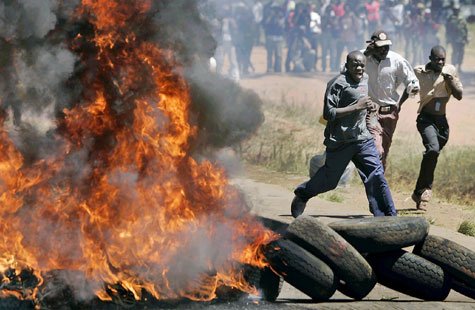
The deadly chaos that erupted in Homa Bay County on Sunday, 16 August 2026, during a Linda Mwananchi rally has forced a stark, long-lasting national question back into the open: Is Kenya sliding once again toward the organised political violence that has haunted its elections in the past?
Homa Bay violence…
Armed youths, widely referred to as goons, blocked major roads with stones, logs and boulders, attacked political convoys, torched vehicles, assaulted journalists and even stormed a hospital in search of the injured. Two people died, including a police officer struck by a stone and a civilian run over in the mayhem. Dozens more were injured by machetes, stones and gunfire. Property was destroyed and fear spread across the county.
What makes the episode particularly alarming is the evidence of premeditation. Reports indicate that youths were recruited days in advance, some ferried from neighbouring Migori County, and paid between KSh 2,000 and KSh 4,000 each. The aim, according to multiple accounts, was to prevent a rival political faction from operating freely in an area claimed as an ODM stronghold.
This was not a spontaneous crowd disorder. It displayed the classic features of political goonism: Paid mobilisation, territorial exclusion, attacks on the media, and the targeting of political opponents. These are the same tactics that have preceded election-related bloodshed in previous cycles.
The political response has deepened concern rather than eased it. Leaders on both sides have traded serious accusations of financing and organising the violence. Homa Bay Town MP, Peter Kaluma, has pointed to opposition figures and alleged large cash transfers; Linda Mwananchi leaders have demanded the arrest of local leaders they claim orchestrated the attacks, including allegations of state collusion. Mutual blame has replaced any shared commitment to accountability.
Police arrested 37 suspects found with crude weapons and have promised further investigations. Yet questions remain about whether the response was timely or sufficiently robust. Roadblocks were allowed to form, journalists were left vulnerable, and a hospital was invaded. The National Cohesion and Integration Commission has summoned key politicians over inflammatory remarks and warned against the use of youth for violence. The Kenya National Commission on Human Rights has gone further, documenting a series of similar incidents across the country between June and August 2026 and calling for firm action against organised gangs and incitement ahead of the 2027 elections.
Broader context ahead of 2027…
These developments occur against a backdrop of intensifying factional battles, particularly in Luo Nyanza following the death of Raila Odinga, and a broader pre-election atmosphere of realignment and rivalry. When political competition is conducted through paid enforcers rather than ideas and persuasion, the risk of escalation is real.
Kenya has made significant democratic progress since the darkest days of post-election violence. The Constitution protects freedom of movement, assembly and political association. Yet those rights mean little if armed groups can close roads, burn vehicles and intimidate opponents with relative impunity.
Whether Kenya is truly sliding back toward election violence will be determined not by the scale of one weekend’s chaos, but by what follows. If investigations stop at the foot soldiers and ignore the organisers and financiers; if inflammatory rhetoric continues unchecked; and if political leaders treat violence as a legitimate tool of competition, then the slide will accelerate.
The alternative is clear and urgent. Security agencies must pursue full accountability. Oversight bodies must act without fear or favour. And political leaders of every faction must publicly and consistently reject the use of goons. Anything less risks turning the run-up to 2027 into a contest decided by force rather than by the ballot.
Kenya has been here before. The question now is whether it chooses a different path.
For more, click HERE to join our WhatsApp channel!





Add Comment