










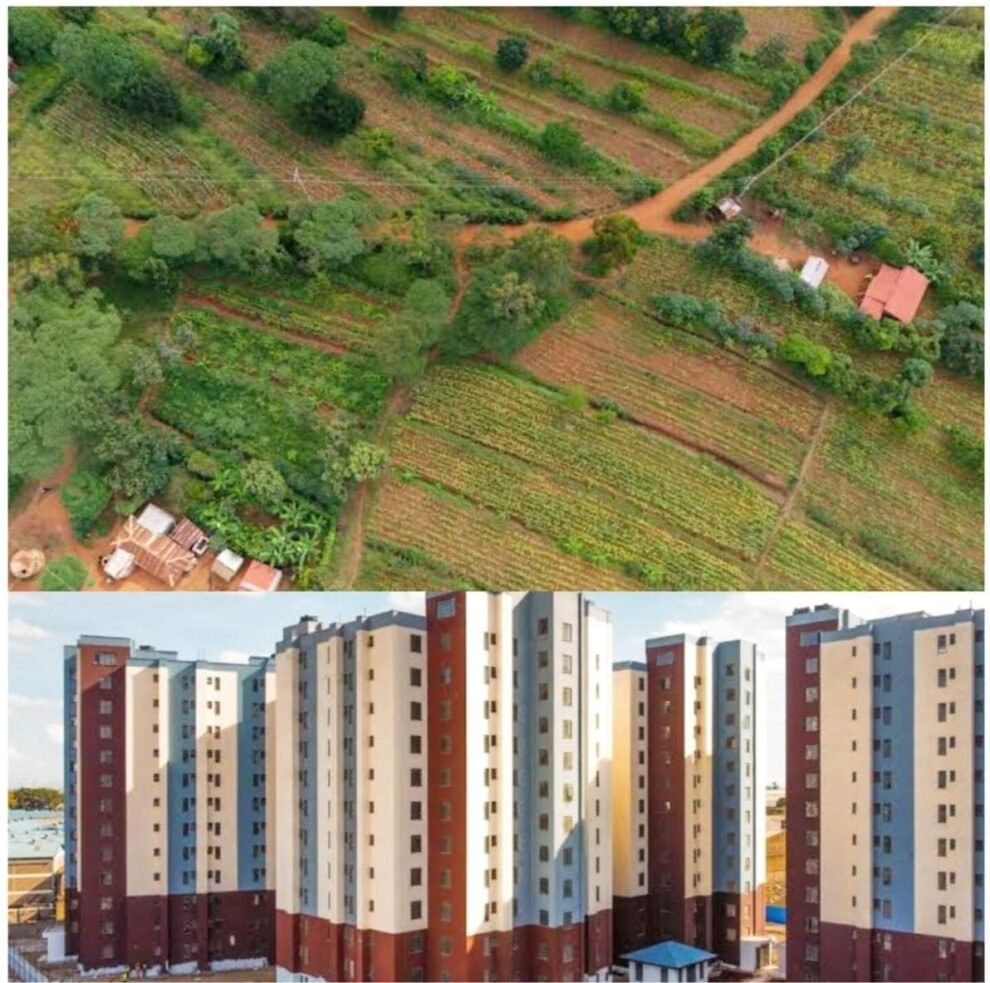
That is the pointed question at the heart of a growing national conversation in Kenya, sparked by President William Ruto’s repeated calls linking the Affordable Housing Programme to the protection of agricultural land.
Ruto’s vision: stop carving up the farms
President Ruto has argued for some time that Kenya’s productive farmland is under threat from constant subdivision. Families, he says, keep dividing plots so that children can build homes, gradually turning once-viable farms into scattered residential patches too small for meaningful crop or livestock production. The result, in his view, is a long-term risk to food security.
His solution is straightforward in principle: stop building houses on agricultural land and instead move into the government’s planned affordable housing estates. The land that would otherwise have been sliced up for homes can then remain under cultivation.. for tea, coffee, dairy, sugarcane, maize and other crops that generate income and feed the country
In Nandi County in October 2026 he put it bluntly to tea farmers: leave the plantations alone, stop constructing scattered houses and toilets across the fields, and come and live in the affordable housing units in town. Keep the land for commercial production and put money in your pocket. Similar messages have been delivered in Kisumu, Kakamega, Murang’a and elsewhere. The Affordable Housing Programme is presented not only as a way to provide decent homes and create jobs (the government cites over a million linked jobs and hundreds of thousands of units under construction), but as a deliberate land-use strategy to curb fragmentation.
The idea is one of organised settlement rather than forced expropriation. Ruto speaks of land consolidation, planned estates and living in denser, serviced communities so that larger contiguous pieces of farmland stay productive. Public land and parcels transferred from state agencies are being used for many of the housing projects, reducing the need to eat into private agricultural holdings.
The question that follows
Yet the practical implication for many rural households feels sharper than the policy language. If the government wants the land kept for agriculture and is offering (or directing people towards) affordable houses as the alternative, the everyday question becomes:
Are you willing to give up, or at least stop living on and subdividing your family’s land so that it remains available for agriculture, and relocate to one of the new affordable houses?
For some, the answer may be yes. A modern unit with water, electricity, sanitation and proximity to services can look more attractive than a fragmented plot that no longer supports a viable farm. The rent-to-own or purchase models, social housing options, and the promise of planned neighbourhoods are part of the government’s pitch. Supporters argue this is the only realistic way to protect food production while still meeting Kenya’s huge housing need.
For others, the answer is a firm no. Land carries deep cultural and economic meaning. It is inheritance, identity, security and often the only real asset a family has. Moving into a government or developer-built estate can feel like losing autonomy, risking higher long-term costs, or being pushed into an unfamiliar urban or peri-urban lifestyle. Sceptics also question whether the housing will truly be affordable for ordinary rural families, whether the quality and location will match the promises, and whether the policy might gradually shift control or use of land in ways that favour larger commercial interests over smallholders.
A conversation Kenya needs to have
Ruto’s position frames the choice as necessary for the country’s future: continue the old pattern of endless subdivision and risk chronic food insecurity, or embrace denser, planned living and keep the land working. Critics counter that genuine solutions must also include stronger rural livelihoods, better farm support, clearer land rights and genuine choice rather than pressure.
The guiding question remains personal and practical. Would you, or your family, be prepared to leave the land you know so that it stays available for agriculture, and take up residence in one of the new affordable houses?
Click HERE to join our Whatsapp Channel





Add Comment