










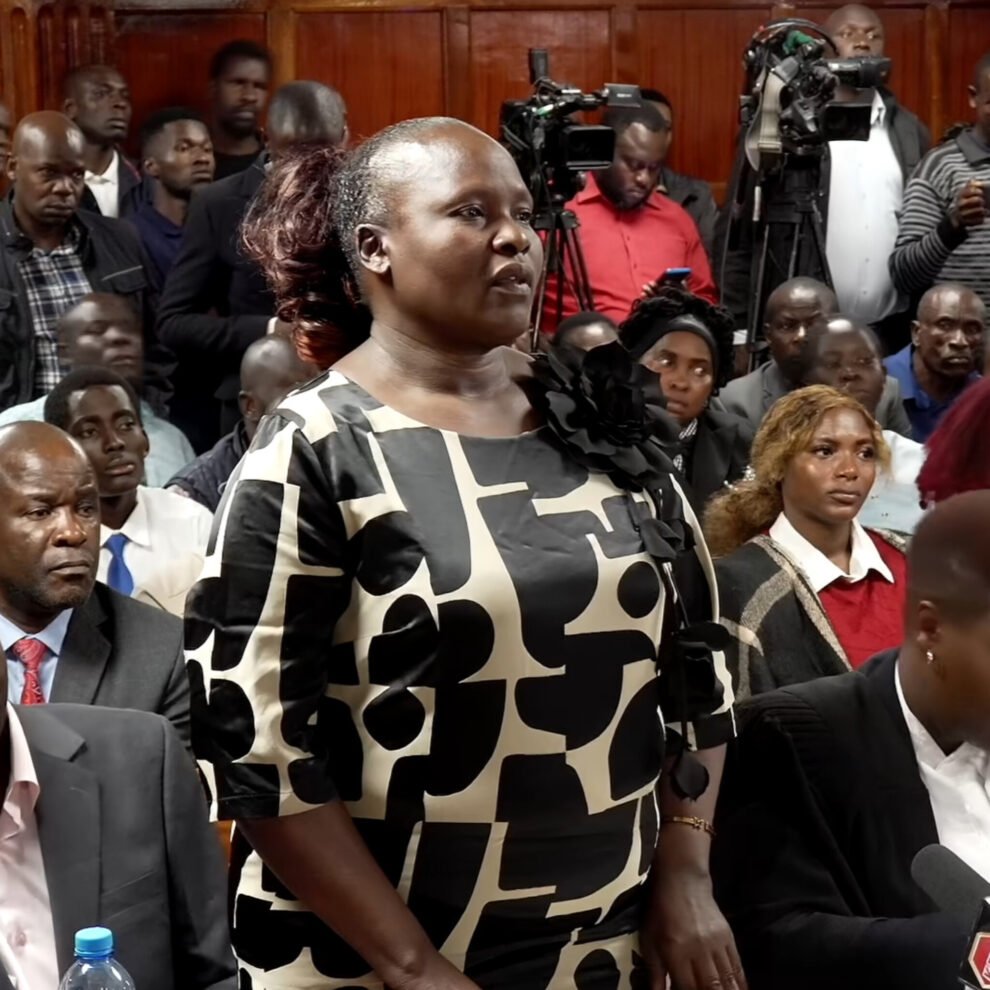
In a Nairobi courtroom this week, something deeply unsettling unfolded. Melida Auma, the mother of Sharon Otieno, stood before Justice Cecilia Githua and pleaded for mercy, not for herself, not for her murdered daughter, but for the man convicted of killing her.
“Don’t crucify Governor Obado,” she said. “If he goes for death or life sentencing, I’ll see another death in my life. Do me a favour; just don’t take him to jail.”
She went further. “Grant him a non-custodial sentence,” she urged, “so that he can help raise the three children Sharon left behind.”
This is not the justice most people expect. It is a strange, almost inverted form of justice ,one that forces us to confront the quiet, brutal mathematics of poverty, power and an older generation’s hard-earned pragmatism about money.
Eight years of grief
Sharon Otieno was 26, a Rongo University student, and seven months pregnant when her body was found dumped in a thicket in Homa Bay in September 2018. Former Migori Governor Okoth Obado, the father of her unborn child, along with two of his aides, was eventually convicted of her murder in July 2026 after a long, draining trial.
For Sharon’s parents, those eight years were not only about grief. They were about survival. Melida has spoken openly about how the endless trips to Nairobi for court hearings consumed the family’s limited resources. “There is not any time we can do any development in this home,” she once said. “The only development is to go to court.”
Raising three grandchildren, now aged around 9, 10 and 11on a modest rural income while carrying the emotional weight of a high-profile murder case left the household exhausted and poorer.
In this context, Obado’s freedom is not abstract. It is practical. A man of means, even a convicted one, can still write cheques, buy land, build a house, or support school fees. A man behind bars cannot. The mother’s plea is not primarily about forgiveness in the spiritual sense, though she framed it that way. It is about the cold arithmetic of need.
The currency of survival
There is a generational layer here that younger Kenyans often find difficult to accept. For many in Melida Auma’s generation, especially those shaped by scarcity, justice is not always pure retribution. Sometimes it is transactional. Money is not just money. It is the difference between children eating and children going hungry, between a roof and the rain, between dignity and quiet humiliation.
This does not mean the older generation lacks moral clarity. Melida and her husband Douglas have been clear that they have forgiven Obado because of what they see as remorse and reconciliation efforts. Douglas, in particular, drew a sharp line; he can live with leniency for Obado, but remains bitter toward the co-accused, Michael Oyamo and Caspal Obiero, whom he described in visceral terms of rage.
Yet the practical request remains; Keep the man with resources free so the children can benefit. In a society where the state offers little meaningful support for orphans of violent crime, and where court processes themselves become another form of impoverishment, this calculation makes a certain grim sense.
True justice should not depend on the wealth of the offender or the poverty of the victim’s family. A justice system that effectively allows a convicted murderer to buy a softer outcome through the very resources that made him powerful in the first place is a system that still privileges class. The fact that the victim’s own mother feels compelled to make this bargain is not evidence of her moral failure. It is evidence of the system’s failure.
At the same time, dismissing her plea as pure greed or moral weakness ignores the lived reality of many Kenyan families. When the state cannot guarantee support for three children whose mother was murdered, the grandmother is left to negotiate with the only person who has ever shown the capacity to help.
This is the uncomfortable truth many prefer not to examine.Poverty does not only create crime. It also reshapes the very meaning of justice for those left behind.
The Harder Conversation Kenya Needs
Sharon Otieno’s case was always about more than one woman’s death. It was about power, gender, class, and the long arm of influence. The mother’s courtroom plea has now made it about something even more intimate.The price of survival in a country where formal justice and material security rarely walk hand in hand.
We can admire Melida Auma’s capacity for forgiveness while still feeling disturbed by the terms on which it is offered. We can respect her right, as a secondary victim, to speak for the practical future of her grandchildren while insisting that a murder conviction should carry consequences that cannot simply be bargained away.
The court will decide the sentence in the coming weeks. Whatever the outcome, this moment has already revealed something important. For some families, especially older ones carrying the weight of both loss and poverty, justice is not only about punishment. It is also about whether the children left behind will eat, go to school, and have a chance at a life less marked by the violence that took their mother.
That is not the justice we like to write about. But it is the justice many live with every day.




Add Comment