










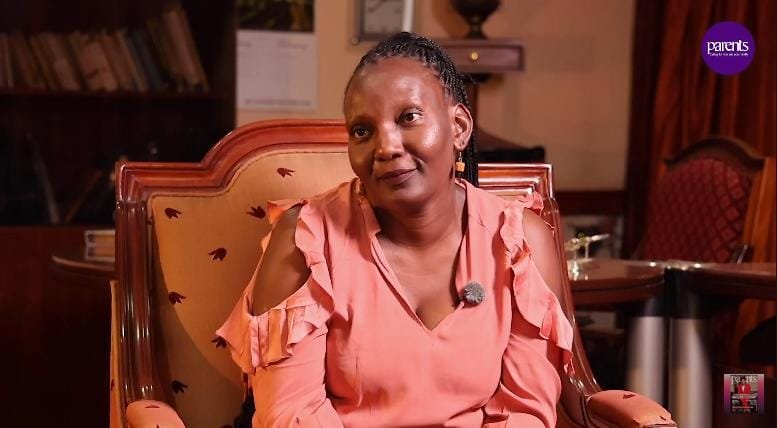
For years, the name Eunice Musila was synonymous with trouble at her former high school. Whenever there was noise, unrest, or an incident involving students, one name kept coming up: Musila.
Today, however, Eunice looks back at that chapter of her life with remorse rather than pride. The former high school strike organiser is now using her experience to speak to students, parents and teachers about the consequences of school unrest, the importance of listening to young people, and the power of choosing a different path.
Her story is not simply about a rebellious teenager. It is also about a young girl who felt rejected, misunderstood and unheard, and who eventually learned that her circumstances did not have to determine the person she would become.
A difficult start…
Eunice began her primary education at Machakos Primary School before completing her primary education at St. Teresa’s. She later joined Kaliluni High School. Her transition to high school was difficult. She says she experienced bullying, particularly from a head girl, and eventually transferred to an army school before returning to Kaliluni. It was during this period that she first encountered student unrest. “I came to encounter the first strike reversal. From that point, it gave me a hint of how a strike can be handled or led,” she recalls.
By Form Three, Eunice says she had become increasingly frustrated with her circumstances. She repeated Form Three twice, meaning she spent considerably longer in high school than she had anticipated. She had expected to complete Form Four in 2006 but eventually finished in 2008. “I was in school while my mind was telling me I should be out. My colleagues were out searching, and I was still in school. It made me furious and I was asking myself, ‘What am I doing in school?'”
That frustration became part of a much bigger emotional struggle.
When being labelled became an identity…
Eunice says one of the experiences that affected her most was feeling that teachers had already formed an opinion about her. Even when she was not involved in trouble, she felt that her name was automatically associated with it. “In anything that happened in that school, who is making noise? Musila. It was just my name. Even in the parade, my name was all over,” she says. Instead of motivating her to change, the constant labelling had the opposite effect. She began questioning why she should continue behaving well if she would be blamed anyway.
“That made me furious. I asked myself, why should I be good all the time when my name is being mentioned on the other side? Why can’t I stay on the other side?” Looking back, Eunice recognises how damaging that mindset became. She says she often felt rejected and unwanted, particularly when she tried to communicate with teachers. At one point, when she reported feeling unwell, she says she was accused of pretending. “I felt unheard,” she says.
For Eunice, those experiences compounded an already difficult childhood.
The roots of her rebelliousness…
Eunice does not deny that she was naturally rebellious. However, she believes her behaviour was also shaped by her experiences at home. She describes growing up in an environment where she was frequently beaten and says the experience hardened her emotionally. “When you beat a child all the time, that child becomes hardened. You don’t soften that child anymore,” she says. The combination of her childhood experiences, peer pressure, conflict with teachers, feeling misunderstood and frustration over repeating classes created what she describes as a rebellious teenager.
Peer influence also played a significant role. Eunice says she often placed her friends ahead of her parents and ignored advice from adults. “My friends were the people I listened to. Even if you gave me advice, I wouldn’t listen.” It was this combination of circumstances that eventually led her into organising school unrest.
The strike that changed everything…
Eunice became involved in organising a strike while still a student. At first, she attempted to distance herself from the unrest, but eventually her role became known. She recalls that the students had grievances they wanted addressed, including water shortages and disagreements over aspects of school life. At the time, some of those issues felt significant to the students. With hindsight, however, Eunice says the consequences were far greater than the issues they were attempting to address.
The planned unrest was eventually discovered before it could fully unfold. Eunice was arrested alongside other students and faced disciplinary action. That moment became a turning point. “I just wished that all things would go back to normal. I asked myself, how did I find myself here?” The consequences extended beyond her. According to Eunice, many students were suspended or expelled, including students whom she believes were not directly responsible for what had happened.
Parents were also left dealing with unexpected financial and emotional consequences.
“My mother fainted”
The impact on Eunice’s family was immediate. When her mother learned that Eunice had been arrested, she fainted. “She said, ‘You know what you did to me? I fainted. You did a strike. You!’ It was chaos.” For Eunice, the reaction made her understand that her actions had consequences beyond herself.
A student’s decision to participate in school unrest can affect an entire family, she says, particularly when parents have already made significant sacrifices to keep their children in school. She also points to the financial burden families face when school property is damaged and parents are required to replace or repair it.
“A parent may be budgeting for school fees and then a strike happens. It really hurts,” she says.
The moment she understood the consequences…
Being arrested forced Eunice to confront the seriousness of her actions. She says she had previously focused on the immediate excitement and anger surrounding the unrest without thinking deeply about what could happen afterwards. “I didn’t have the motivation to study for the exam. Anyway, it was something else.”
Today, she believes that one of the biggest lessons students need to understand is that every decision has consequences. “Before doing anything, ask yourself: when I do this, what are the consequences? What are the results?” She strongly discourages students from viewing strikes as a solution. “Nothing good will come out of a strike. You’ll end up messing yourself up and later regretting, ‘Why did I do this?'”
From rebellion to reflection…
The years after high school were not immediately easy. Eunice worked as a professional beautician and says she earned good money, but she struggled to understand where her money went. She also found herself surrounded by people whose lifestyles did not always align with her own. Over time, she began reflecting on her choices and where her life was headed.
Then came another important experience. In 2023, she visited a school for visually impaired children in Machakos. The experience deeply humbled her. “I had never interacted with people with different abilities. That humbled me up to date.” She began appreciating things she had previously taken for granted. “You don’t know the next hour. Any time. So I appreciate every single hour I find myself okay.”
Her perspective continued changing in 2024. While receiving medical care, Eunice encountered children undergoing treatment at Kenyatta National Hospital. She describes meeting seriously ill children as an experience that profoundly affected her. She remembers holding one crying child and experiencing a sense of peace. That moment revived an old dream.”I wanted to become a nurse, but I didn’t know how.”
Although she did not have the grades to pursue nursing, someone suggested that caregiving could offer another way of working with children. Eunice says she immediately connected with the idea. “It made me feel like I want to live again. I said I will be a caregiver. It is in me.”
Learning humility and forgiveness…
Today, Eunice says one of the biggest lessons life has taught her is humility. She has also learnt the importance of accountability. “When you do good, good shall come through. When you do bad, bad shall come through.”
But accountability, she says, also requires learning to forgive yourself and take responsibility for the person you want to become. Eunice would particularly like to apologise to her former principal, Mrs Susan Musimba. “I would want to tell her that I’m totally sorry for what I did. I never did the strikes knowingly. I just want to tell her that I’m sorry from the deepest part of my heart and I wish her to forgive me.”
She says she has also tried to reconnect with former teachers in search of closure.
Her message to students today…
Eunice now sees her past as something she can use to warn other young people. Her message to students considering unrest is simple: stop and think. She believes students need safe channels through which they can raise concerns, but they must also understand that destruction and violence can create consequences that last long after the immediate conflict is over. She also believes schools have a responsibility to listen.
“One, when they speak out, they’re not heard. That’s the major.” For teachers, she says changes in student behaviour should not be ignored. In her experience, small changes in attendance, behaviour or group dynamics can sometimes indicate that something is wrong. Her advice is for teachers and school administrators to ask questions and engage students before frustrations escalate.
Parents need to look beyond providing…
Eunice’s transformation has also changed how she views parenting. As a mother, she says she has become more attentive to children’s emotions and behaviour. “You can tell when a child is happy, sad, all that.” She believes parents sometimes focus heavily on providing for their children while overlooking the need for emotional connection.
“Caring and providing is all that, but it isn’t. There is loving and understanding your child and getting to know what my child can do and what this child cannot do.” For her, listening is part of parenting. A child who feels heard at home may be more willing to communicate when something is going wrong at school.
A new dream…
Eunice is now focused on rebuilding her life around a different purpose. She has stepped away from professional beauty work and is currently keeping busy with farming while pursuing her dream of becoming a caregiver. Her goal is to return to school and study caregiving, particularly paediatric care. She has identified Kismet International College, where she hopes to pursue a course that will allow her to work with children. At the moment, however, finances remain a barrier.
She hopes to find sponsorship or support that can help her return to school. “I don’t have the means, but I just want to go and do it.”
“You did what you did. It wasn’t right”
Perhaps the most powerful part of Eunice’s story is the conversation she would have with her younger self. She would not excuse her behaviour. Instead, she would acknowledge it, take responsibility and encourage the girl she once was to use her intelligence differently.
“I would tell the little Eunice, you did what you did. It wasn’t right. You hurt so many souls. You had the brains and you should have used those brains to better yourself.” Today, she says she is proud of herself for being able to forgive herself, grow and focus again.
Her story is ultimately one of accountability and redemption. The rebellious teenager who once believed she had nothing to lose now wants young people to understand exactly what they stand to lose when anger takes over.
Her message to students is clear: your circumstances may influence you, but they do not have to define you. Think about the consequences, seek help when you feel unheard, and never underestimate the power of choosing a different path.
For more, click HERE to join our WhatsApp channel!




Add Comment