










This article was originally published in the August issue of 2010
By Tabitha Onyinge
It is rare that a tree crashes onto a moving vehicle. It is even rarer that a tree crashes onto a car moving very fast along a highway on a calm day, yet it happened on Nairobi’s Uhuru Highway nearly two years ago. Mary Mwaniki was riding home in a taxi on October 3, 2008, when a eucalyptus tree standing tall by the roadside suddenly crashed onto the car. “It happened so fast; all I remember is waking up at the Aga Khan University Hospital many days later,” Mary recalls. She remained at the Aga Khan University Hospital for one month of intense treatment before being transferred to a hospital in India for specialised treatment.
It was in India that she made the horrifying discovery – she had sustained severe spinal cord injuries. She had lost mobility and motor functions and would not be able to grip, walk, grasp, or even feel most of her body again for the rest of her life.
“The doctors at the Aga Khan Hospital did not reveal to me the extent of my injuries despite being under their care for a whole month, can you imagine?” Mary asks rhetorically. “Did they think I was going to commit suicide?” Mary laughs and then adds, “Such are the attitudes that make our lifespan shorter.” She is referring to spinal cord injury patients whose research has found do not live beyond five years after injury. Knowing what spinal cord injuries entail, especially how the quality of your life depreciates, would mark the end of most people’s lives, but not Mary’s.
“Of course, at first I went through confusion, with different emotions clashing within me, but then I told myself, ‘girl, you had better accept your new status before it’s too late…’ I had a choice between life and death; I chose life,” she says. That is where Mary’s life and story really begin. She had a literal rebirth in a new body – a body that was practically not hers.
For the six months she was in India, Mary obediently took her pain-relieving medication and underwent counselling and physiotherapy to prepare her for the new life ‘God had handed her’. The greatest step towards healing was, however, not what the doctors, counsellors and physiotherapists did, but what she did. Mary quietly did her own self-preparation to enable her to face her new life as a healthy and well-balanced person.
“Most people who have suffered spinal cord injury never accept their new selves. I realised that to be accepted by others, I had to accept myself first. So day after day, I reminded myself of the blessings I still had despite losing some of my faculties. I realised that my brain was still intact – strong and good. What else could I ask for?” she says.
Strong-willed does not adequately describe the glimpse I have of Mary’s mindset. She is a focused person with the determination to make something of her life, whether in perfect health or not. “I am naturally a go-getter and realising I had not lost that after the accident was humbling. I resolved to remain focused, take courage, work hard and employ my inner strength to achieve the goals I still had pending in life. After all, I had family support,” she says cheerfully, attributing it to her ‘three-walled empire’ – her protective guard.
“The innermost wall is occupied and guarded by God, the second by family and close friends, while the outer one by the rest of the people… I fight tooth and nail if anyone threatens to block my joy, because that is where I draw my strength from,” says Mary.
A lot of things Mary did during recovery and continues to do 18 months later today have surprised, nay, confused many a people who know her, except herself. At the hospital in India, Mary was the first spinal injury patient to willingly enrol for sex therapy, not only surprising her doctors but also her husband, John Nyaga.
“Look at me, is there anything I lack now that I am in a wheelchair?” she asks a question that may have propelled her into making that decision. “Many people think people confined to wheelchairs do not have sexual feelings,” she adds. The couple went through physical and emotional therapy to ensure continuity in their relationship. “The process is very informative and important to discordant couples like us.”
That was just the first of many surprises Mary was yet to give those who know her. Just a week after arriving in Kenya from India, she arose early one Monday morning, ready for work. Her husband, friends and relatives were shocked. They did not believe she was ready to do anything just yet. “They just did not seem to understand who Mary really is,” she quips.
Needless to say, Mary was still making adjustments to her new physical state. From a very quick and independent person, she was suddenly reliant on an assistant to do nearly everything. “I had to learn to share my private space with someone else other than my husband. Being turned in bed in the middle of the night and being bathed are, today, the least of my problems. I no longer have any secrets,” she explains.
Nevertheless, still unaccustomed to her new lifestyle, the mother of two returned to her busy job as principal of Wisemen Trainers and Consultants Limited in Nairobi. Mary and her husband are co-directors of the training institution that is affiliated to the Jomo Kenyatta University of Agriculture and Technology and Limkokwing University of Creative Technology in Malaysia.
Motivation given, motivation received
Returning to work was one of the best moves she made at the time, despite the fact that she could no longer use her fingers to perform even simple tasks like typing on the computer. Staff and students at the college gave her a warm reception that reignited her determination to give her best to the institution. She goes to work daily between eight and five, sometimes staying till eight in the evening. Naturally, she noticed a lot of peculiar things happening around her, but the most effect they had on her was an occasional irritability, which she quickly dealt with.
“You can only notice the ridiculous things people do to people with disability if you are one, or if you hang around people with disabilities,” she states. “Of course, I noticed the oddness more because I was newly disabled and perhaps that was why I was also able to deal with it fast.”
For instance, she would be moving through a congested street when, instead of giving her way, some pedestrians would impulsively try to lift her off the ground to “help. How humiliating!” she remarks. Most people Mary finds in a lift always assume she is on her way to see a doctor and will offer to help her out when the lift stops on a floor occupied by doctors. “Sometimes they remind me that there are no doctors on the floor I’m headed to,” she says with amusement. “In the eyes of many, a person with disability is a sick person, not a normal one like the rest of society and that is why God chose people like me to help change this attitude,” she adds.
She summarises people’s attitude towards the disabled as sympathetic, as opposed to the more progressive, empathetic outlook. According to her, the sympathetic approach to survivors of spinal cord injury starts with some counsellors. “Some of them treat us like do-gooders with terminal illness, yet all we need is to be redirected to a change in lifestyle as we are not sick,” she explains.
Christian friends and relatives were the other group of people Mary found bothersome. “You can’t imagine how many times one or another Christian proclaimed that I was going to walk ‘in the name of Jesus’. I believe in the power of God and I know He works miracles, but all these Christians do, especially to weak minds, is push them further into denial,” she says. Mary believes the first step anyone could make with a person who has just had a disability is to help her learn to live with the condition and make the best out of it, and not give them false hope.
The other thing that surprises Mary’s close friends and relatives is her upbeat nature and determination to continue pursuing her hobbies and enjoy life. “I love dancing and hanging out with friends. I still go out on some evenings to have a good time dancing and feasting with friends. This surprises many of them, but the truth is, on the inside, nothing has changed about me. I dream like before and know that the only barrier that can hinder me from achieving anything is me,” she states thoughtfully. It is for this reason that Mary hates the cliché, ‘disability is not inability’. According to her, the statement puts a ceiling on the achievement of people with disabilities. “What that cliché says silently is that there are no successful people with disability,” she explains.
Endowed with the power of inner strength, peace, joy, hope and determination, Mary acknowledges that not everyone is like her. She admits some people need a gentle and compassionate push to jolt them in the right direction. It is for this reason that she is out to help other survivors of spinal cord injury and paralysis lead joyful and fulfilling lives. She established the Mary Mwaniki Foundation in December last year to offer love, care, emotional and psychosocial support, encouragement and hope to survivors and patients with spinal cord injury to enable them to lead productive, self-reliant and fulfilling lives. She also intends to sensitise society to become more supportive and sensitive to such groups of people.
“I know the more motivation I give to others, the more I receive back to continue on my course. Most of us are psycho-economically weak and that is why we need the rest of the world to support us,” she says.
Apart from their daily basic needs, she says that people with disability like hers need lots of money to take care of certain hidden costs that they have to meet daily. “Some need wheelchairs, catheters and even nappies to keep them comfortable and free of infections, but may not be able to afford. This is perhaps the reason most people with spinal cord injury do not live long as they can not afford a decent life,” she says.
Mary depends on a round-the-clock assistant, without whom she would be immobile. This, she says, would be impossible for a person with no income, or better still, dedicated family support. It is for this reason, she says, that most survivors of spinal injury are reluctant to leave the hospital.
Mary visits the government-owned Spinal Injury Hospital at Kilimani to encourage the patients to have a positive attitude. “A doctor in India taught me that a human being is the chest upwards, for that is where the brain to think and make decisions lies. So I try to help patients learn to conquer their minds as I did mine,” she says.
Mary also challenges the government to ease the lives of people with disabilities by following up on the implementation of existing policies. “For now, we continue praying for a scientific breakthrough that will enable implantation of cloned cells to enable us to walk again,” she says with hope.
An upbeat person, Mary says women with spinal injuries are more vulnerable than men in the same situation, as, unlike women, men are not nurturers and caregivers and will often abandon their wives when the burden becomes too much for them to carry. The other challenge that frustrates most women with spinal injury is their inability to care for their families as they would like to. “I was frustrated for some time when I could not wake up early like before to prepare my children for school, or just cook a meal for the family,” she says.
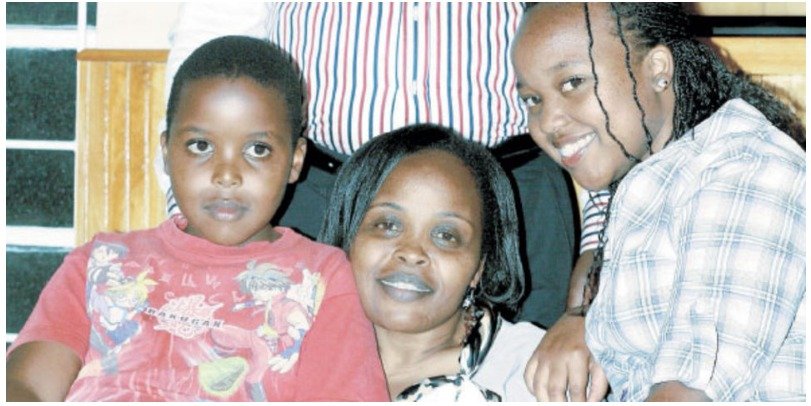
Born in the mid-60s in Kirinyaga District, Mary is the mother of a teenage daughter, Edna, and an eight-year-old son, Mwaniki. She excelled in her studies throughout school, joining Kenya Technical Teachers Training College (KTTC), Mbagathi, for a Diploma in Education. She later obtained a Bachelor of Arts Degree, followed closely by a Degree in Business Administration from Newport University. She was the principal of Computers College between 1995 and 2001 before establishing her own training institution.
Life may just be beginning for this woman with a magnanimous attitude, for she believes there are lots of dreams to be achieved. She runs a strict schedule that revolves around work, therapy, and visits to physically challenged patients in various institutions, yet still has enough time for her family and friends. “I am fully reintegrated into society, viewing life through a new, better window. Most people close to me no longer see my disability and I am living a fulfilled life,” concludes Mary. All this has happened in less than two years after her injury because of the resolve and determination that remain her guiding principles.
This article was originally published in the August issue of 2010
For more, click HERE to join our WhatsApp channel!



Add Comment