
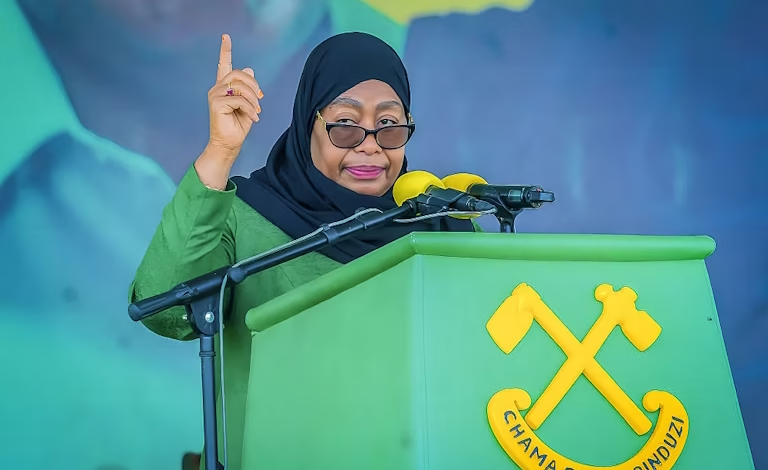

Across Africa, powerful political families have long drawn both admiration and criticism for the influence they wield. From presidential palaces to military headquarters and diplomatic missions, relatives of sitting and former leaders often find themselves occupying senior positions within government. This concentration of authority within family lines has sparked debates on patronage, conflict of interest and the erosion of institutional independence.
Parents, however, may see a different layer beneath the politics: the universal instinct to support one’s children, guide them into opportunity and help them flourish. But when does parental support in leadership cross the line into nepotism? And how does this growing trend shape the future of governance in Africa?
Tanzania has now stepped firmly into this conversation.
A cabinet under scrutiny
President Samia Suluhu retained the presidency after a fiercely contested election in which she secured 98 per cent of the vote, a result heavily criticised by international observers. Days later, she unveiled a new Cabinet that immediately ignited public debate.
In a live address from Chamwino State House in Dodoma, Samia announced 27 ministers and 29 deputy ministers. Among them was her daughter, Wanu Hafidh Ameir, appointed Deputy Minister of Education.
Wanu’s husband, Mohamed Mchengerwa, was named Minister for Health. Both are sitting Members of Parliament, Wanu for Rufiji and Mchengerwa for Makunduchi and their elevation places them among Tanzania’s most politically influential couples.
The appointments did not stop there. Ridhwani Kikwete, son of former president Jakaya Kikwete, was named to oversee Public Service Management and Good Governance in the President’s Office. At 46, the Chalinze MP carries the political legacy of a father widely considered instrumental in Samia’s rise.
Critics argue this sends a dangerous signal: that proximity to power may matter more than merit.
A regional pattern?
Tanzania’s developments echo a broader, decades-long trend across East and Central Africa.
Uganda: A Family at the heart of power
President Yoweri Museveni’s 39-year rule offers perhaps the starkest example of political power concentrated within one family. The First Lady, Janet Museveni, has served as Minister for Education since 2016. Their son, General Muhoozi Kainerugaba, stands at the helm of the military as Chief of Defence Forces, fuelling speculation that he is being groomed as successor.
Their influence extends widely:
-
Son-in-law Odrek Rwabogo, a key presidential advisor
-
Daughter Patience Museveni, President’s Private Secretary
-
Sister Violet Kajubiri, deputy chair of the Education Service Commission
-
Brother General Salim Saleh, senior presidential advisor
-
Stepbrother Shedreck Nzaire, defence advisor
The network even includes in-laws such as long-serving Foreign Affairs Minister Sam Kutesa, Muhoozi’s father-in-law.
South Sudan: A young diplomat draws debate
In South Sudan, President Salva Kiir recently appointed his daughter Adut Kiir as Senior Presidential Envoy for Special Programmes. While she has a strong humanitarian profile, many citizens view the appointment as part of a widening pattern of dynastic governance.
Kenya: Patronage and personal networks
President William Ruto has long been known for rewarding loyalty, and this did not change after he assumed office. Several long-time allies were appointed to senior Cabinet positions, including Aden Duale, Kipchumba Murkomen and Kithure Kindiki.
A flashpoint emerged when he nominated 50 Chief Administrative Secretaries, among them close aide Dennis Itumbi, though the appointments did not go through.
Questions have also been raised about the President’s ties with figures such as Kenya Power managing director Joseph Siror, who admitted they shared a history from their university days as Christian preachers.
The debate over family influence resurfaced when critics recalled the appointment of Ruto’s daughter, June Ruto, as Chargée d’Affaires in Poland in 2019—an assignment made while Ruto was Deputy President.
Equatorial Guinea: A dynasty in waiting
Succession debates in Equatorial Guinea continue to centre around Teodoro Nguema Obiang Mangue, popularly known as Teodorin, the First Vice President and presumed heir to President Teodoro Obiang Nguema Mbasogo. His steady rise through defence and security roles has fuelled expectations of an impending dynastic handover.
Rwanda: Grooming the next generation?
In Rwanda, President Paul Kagame’s two sons have entered national service.
-
Ian Kagame serves in the elite Presidential Guard.
-
Brian Kagame, who graduated from Gako Military Academy in August, is now a Second Lieutenant in the Rwanda Defence Force.
While officials argue these appointments are merit-based, concerns persist about the precedent being set.
Family values vs National values
For parents, it is natural to want to see one’s children succeed. Many families across Africa take pride in raising children to serve the nation. Yet, when families dominate key state positions, important questions arise:
-
Does it undermine fair competition?
-
Do public institutions weaken when accountability is shared among relatives?
-
Are children in these families under more pressure to prove themselves—or less?
-
What message does this send to the younger generation about leadership and opportunity?
Nepotism, in its most harmful form, can erode trust in public institutions, narrow the space for political diversity and concentrate power within a small circle. At the same time, the instinct to guide one’s children is a deeply human one.
In a continent where family bonds are strong and communal ties remain central to identity, this tension between personal loyalty and public duty continues to shape modern governance.
The balancing act
The debate is not simply about politics; it is also about the kind of societies African parents hope to raise their children in fair, transparent and merit-driven.
Leaders insist that their family members are qualified and deserving of the roles they hold. Critics disagree, warning that placing relatives at the heart of government risks weakening accountability, breeding patronage and consolidating power in systems where institutional checks are still developing.
For families across the continent, the lesson is clear: while we strive to open doors for our children, we must also teach them the importance of ethics, fairness and service beyond self.
Because leadership, at its heart, should always be about the people not the family name.