










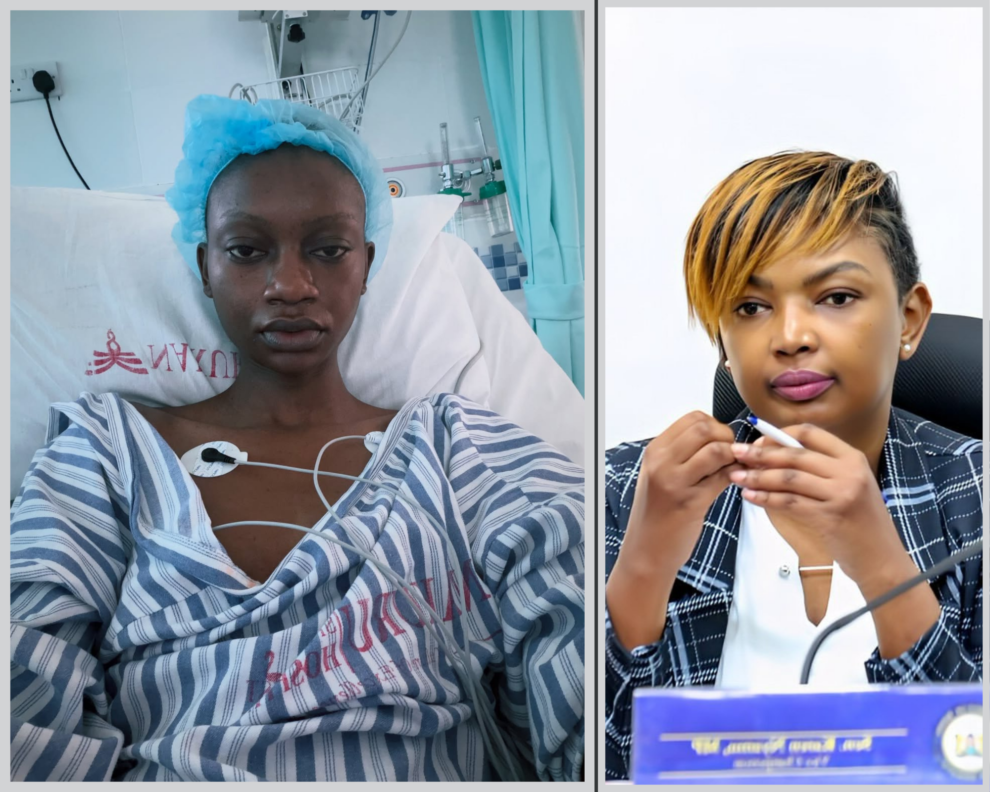
The painful story of Kenyan media personality Natalie Githinji’s battle with stage 4 endometriosis has reignited questions about how Kenya diagnoses, treats and financially supports women living with the condition.
Githinji recently revealed that she had been diagnosed with stage 4 endometriosis after undergoing surgery, describing the experience as her “worst nightmare.” She spent time in the ICU and is now recovering in the hospital.
Her account has since drawn the attention of Nominated Senator Karen Nyamu, who says Githinji’s experience should force Kenya to confront the wider challenges surrounding endometriosis care.
“It’s time we had a national conversation about endometriosis,” Nyamu said in a statement, recalling the death of celebrated endometriosis advocate Jahmby Koikai in June 2024.
Koikai, who lived with severe endometriosis for years and became one of Kenya’s most prominent voices on the disease, died on June 3, 2024, after complications associated with the condition.
Her death prompted renewed attention in Parliament to the state of endometriosis care in Kenya. In July 2024, the Senate formally recognised Koikai’s advocacy, while Parliament subsequently questioned the Ministry of Health about the country’s capacity to treat the disease.
Kenya has 700 gynaecologists, but only five laparoscopic specialists
One of the most concerning issues emerging from the parliamentary discussions is the shortage of specialists trained to manage complex endometriosis cases.
According to information provided by the Ministry of Health to Parliament in 2024, Kenya had about 700 gynaecologists working across the public and private sectors, but only five trained laparoscopic gynaecological surgeons, mainly based at national referral hospitals.
The Ministry also told Parliament that Kenyatta National Hospital and Moi Teaching and Referral Hospital were the two Level 6 facilities able to treat endometriosis at the time. It said the government had invested in laparoscopic equipment and planned to establish specialised endometriosis centres.
The numbers raise an important question: what happens to a woman living outside Nairobi or Eldoret who develops severe endometriosis and needs specialist surgical care?
For patients with advanced disease, access to the right specialist can make the difference between prolonged suffering and appropriate treatment.
Natalie’s story humanises the problem
Githinji’s experience has made those statistics personal.
After learning that her condition had reached stage 4, she described feeling numb and overwhelmed.
“When my Doc told me that nimefika stage 4 ata sikulia,” she said, adding that she simply asked God where she was headed together with other women battling the disease.
She also spoke about the fear she experienced before surgery.
“Like what if nikose kuamka?” she said, describing her thoughts while preparing for theatre.
Following the procedure, she spent time in the ICU before being moved to a hospital room to continue her recovery.
But the medical battle is only part of the story.
Githinji has openly spoken about the financial burden of endometriosis and has appealed for support while she recovers. She has also asked for information on a petition seeking to have endometriosis and women’s reproductive health adequately addressed under the Social Health Authority.
Her experience highlights a question that goes beyond one patient’s medical bill: does Kenya’s health financing system adequately reflect the real cost of living with severe endometriosis?
Is SHA enough?
The question of coverage is particularly important for women with advanced disease, where treatment may involve repeated consultations, diagnostic procedures, medication, specialist care, and, in some cases, surgery and lengthy recovery.
When the government was developing the SHA benefits package in 2024, the Ministry of Health said the new system was intended to make healthcare more affordable and provide financial protection against medical costs. The Ministry also described the package as part of the country’s move towards universal health coverage.
But Githinji’s appeal suggests that women living with severe endometriosis want a closer examination of whether the available benefits actually meet the costs they face.
Nyamu says this is one of the questions she intends to pursue.
“I’m committed to taking this conversation further,” she said, outlining plans to interrogate whether SHA adequately meets the real cost of endometriosis care, push for national data and specialist capacity, and listen to women living with the disease.
She also said she intends to reach out to Githinji and support her through her recovery.
Kenya still needs better data
Another major concern raised by Nyamu is the lack of comprehensive national data on endometriosis.
When the issue was raised in Parliament following Koikai’s death, lawmakers sought information on the number of specialised facilities available and the country’s capacity to provide treatment. The parliamentary discussions highlighted gaps in specialised care and the need for greater awareness.
Without reliable national data, it becomes difficult to determine the true scale of the problem, plan specialist services, allocate resources or measure whether interventions are actually improving women’s health outcomes.
The government has previously said that awareness campaigns, continuous medical education and community health promotion are part of its strategy to improve early diagnosis and treatment.
But for women already living with severe disease, awareness alone is not enough.
They also need accessible diagnosis, specialised treatment, affordable care and a health financing system that does not leave families struggling to meet the cost of treatment.
From Jahmby to Natalie
Koikai spent years using her own experience to demand better care for women with endometriosis. Her death brought national attention to a condition that many women had struggled to explain and had taken seriously.
Now, Githinji’s story has reopened that conversation.
Her words (spoken from a hospital bed after surgery and ICU care) demonstrate the human cost behind the statistics.
Nyamu says the issue should not be reduced to politics or public relations.
“This is not about politics or PR. I genuinely want to see what we can do, as a country, to bring endometriosis under control,” she said.
For thousands of women living with endometriosis, the question is no longer whether the country knows the disease exists.
It is whether Kenya can build a system where a woman does not have to reach stage 4, face a devastating financial burden or publicly appeal for help before she can access the care she needs.
For more, click HERE to join our WhatsApp channel!



Add Comment