
Editorial
Breaking Generational Parenting Cycles

How to Parent Differently from How You Were Raised
They say history repeats itself, but when it comes to parenting, does it have to?
Picture this: You’re standing in your kitchen, watching your child struggle with something—maybe tying their shoes, finishing homework, or processing a big emotion. And then, before you even think, the words fly out: “Why are you crying? That’s nothing to cry about!” Or maybe, “When I was your age, I had it ten times harder.”
You freeze.
It’s like you’ve been possessed—by your parents.
The very words you swore you’d never say, the ones that stung you as a child, have now left your lips. And in that moment, you realize: You’re at a crossroads. You can keep the cycle going, or you can break it.
The Weight of the Past
Let’s be real—our parents did the best they could with what they had. They raised us with love, discipline, and sometimes, a little (or a lot) of tough love.
 Many of us grew up in homes where emotions were dismissed, strict discipline was the norm, and the phrase “Because I said so” ended all arguments.
We were taught to obey, to toughen up, to respect authority without question. But now, as parents ourselves, we’re realizing something crucial: Not everything we learned should be passed down.
The truth? Some of those lessons left wounds. And unless we actively work to change things, we might unintentionally pass those same wounds onto our children.
Recognizing the Cycles
Breaking generational cycles isn’t about blaming our parents. It’s about recognizing patterns that no longer serve us and making intentional changes.
Ask yourself:
- Do I dismiss my child’s feelings because mine were dismissed?
- Do I use harsh discipline because I was raised in fear-based parenting?
- Do I struggle to say “I love you” because affection wasn’t common in my home?
- Do I push my child to be “perfect” because I was only praised for achievement?
If any of these resonate, congratulations—you’ve taken the first step: awareness.
Parenting Differently: What That Looks Like
1. Creating Emotional Safe Spaces
Growing up, many of us heard, “Stop crying or I’ll give you something to cry about.”
But what if, instead, we told our kids: “It’s okay to feel sad. I’m here for you.”
Children who feel safe expressing emotions grow into adults who understand their feelings rather than suppress them.
Instead of shaming big emotions, let’s teach our kids how to process them.
2. Communication Over Control
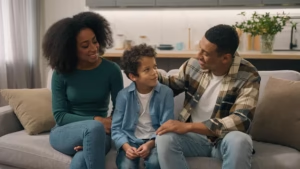 Old-school parenting relied on authority—kids obeyed without question. But what if we swapped control for connection?
Instead of shutting down a child’s questions with “Because I said so,” try explaining why. Instead of demanding respect, model it.
Children learn from what we do, not just what we say.
3. Discipline, Not Punishment
Discipline means teaching, not hurting. Spanking, yelling, and fear-based tactics might get quick results, but they don’t build emotionally strong kids.
Try this instead:
- Set clear boundaries, but enforce them with love.
- Use natural consequences instead of harsh punishment.
- Teach kids why their actions matter, instead of just punishing them for mistakes.
4. Breaking the Silence on Mental Health
For many of us, mental health wasn’t a conversation at the dinner table. Therapy? That was for “crazy” people. Anxiety? “You just need to pray more.”
But now, we know better. Let’s normalize mental health conversations in our homes. Let’s teach our kids that it’s okay to struggle, okay to ask for help, and okay to take care of their minds the same way we care for our bodies.
5. Showing Love Beyond Survival
 Many of us grew up in homes where providing food and shelter was considered love. But love isn’t just about survival—it’s about connection.
Tell your kids you love them. Hug them.
Spend time with them, not just when they’re behaving well, but when they’re struggling, too.
Love should never feel earned; it should always be felt.
The Beautiful (and Messy) Journey of Change
Here’s the truth: Breaking generational cycles isn’t easy. Some days, you’ll catch yourself slipping into old patterns. Some days, you’ll feel like you’re failing. But parenting differently doesn’t mean parenting perfectly—it means parenting intentionally.
So, when you find yourself about to repeat a pattern from your childhood, pause. Breathe. And ask yourself: Is this the parent I want to be? If not, you have the power to choose differently.
Because at the end of the day, parenting isn’t just about raising our children—it’s about healing ourselves, too.
And that? That’s how we change everything.











You must be logged in to post a comment Login